Delhi’s Ramleela Provocation: A 30-Foot Cockroach Effigy Joins the Divine Drama
The inclusion of a 30-foot cockroach effigy alongside traditional figures like Ravan and Kumbhkaran in Delhi’s Ramleela has sparked controversy, reflecting the increasing politicisation of religious festivals. This symbolic act is seen as a direct challenge to political opponents, blurring the lines between spiritual observance and partisan warfare.
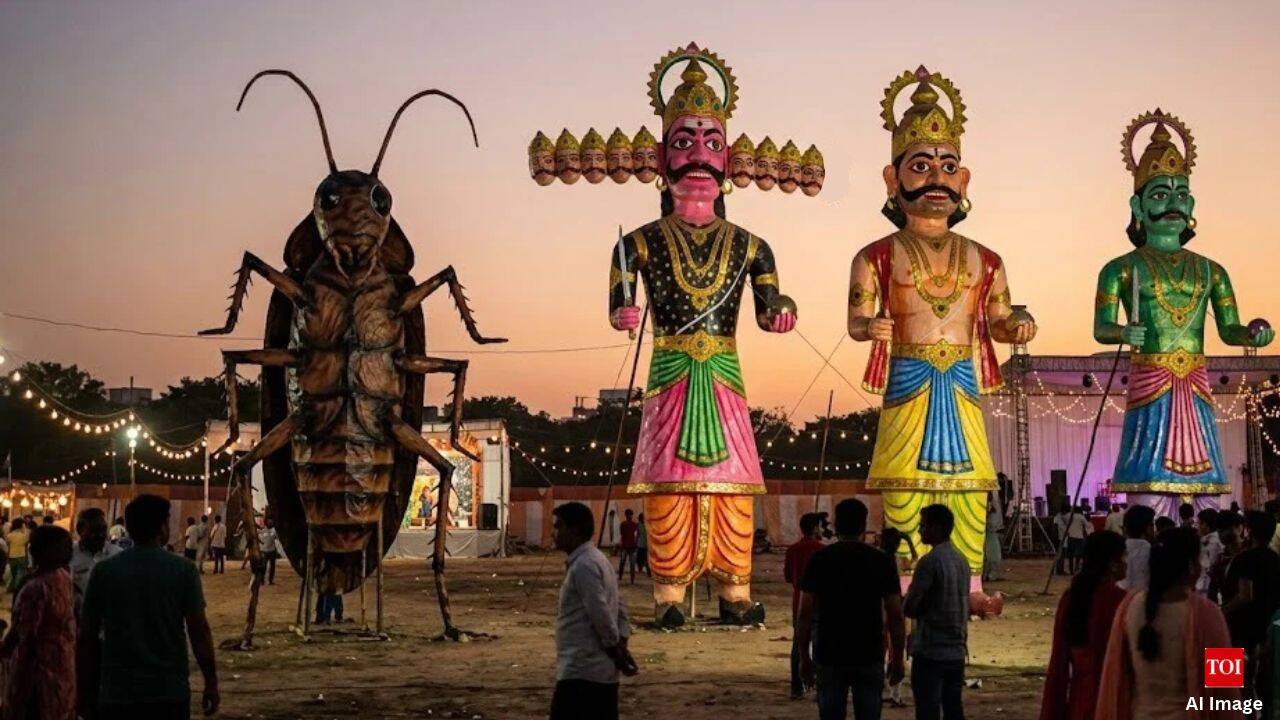
The Ramleela in Delhi, a traditional religious festival, has taken on a new and provocative dimension with the inclusion of a 30-foot cockroach effigy. This effigy, placed alongside traditional figures such as Ravan, Kumbhkaran, and Meghnad, is widely interpreted as a political statement against the opposition. The decision to include this symbol is a deliberate act of provocation, aimed at mocking political rivals and asserting dominance. The immediate shockwave is a wave of criticism from political opponents and civil society, who see this as a misuse of a religious platform for partisan purposes. The incident highlights the increasing politicisation of religious festivals, which are traditionally meant to be apolitical and inclusive.
The underlying tension is rooted in the deep political divisions in Delhi, where the ruling party and the opposition are locked in a fierce battle for power. The institutional friction is evident in the use of public spaces and religious symbols for political ends, which undermines the secular nature of the state. The decision to include the cockroach effigy is a reflection of the aggressive political culture that has taken hold in Delhi, where every opportunity is used to attack opponents and rally supporters. This trend is concerning, as it erodes the shared cultural and religious heritage that binds the community together.
The downstream consequences of this incident are significant. The politicisation of religious festivals is likely to increase, with other parties using similar tactics to attack their opponents. The credibility of the religious institutions is damaged, and the public’s trust in the secular nature of the state is eroded. The tangible outcome is a more divided and polarised society, where religious and political identities are increasingly intertwined. The long-term effect will be a further erosion of social cohesion, as communities become more fragmented along political lines. The incident serves as a warning that the secular fabric of Indian society is under threat, and that immediate action is required to restore the apolitical nature of religious festivals.
Comments 0