Kolkata's Exporters Pivot West as US Tariff Pressure Intensifies
Facing escalating American tariff barriers, Kolkata's export sector is aggressively redirecting trade flows toward the United Kingdom, the European Union, and Japan. This strategic pivot aims to mitigate revenue losses and preserve market share in a rapidly fragmenting global trade environment.
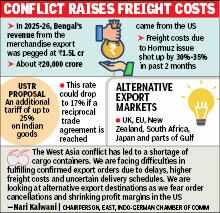
The concrete rupture in Kolkata's export is defined by a decisive turn away from the United States, a market that has historically commanded a significant share of the city's industrial output. As American tariff policies tighten, local exporters are finding their traditional channels blocked, forcing an immediate and costly realignment of their commercial strategies. This is not merely a logistical adjustment but a fundamental restructuring of trade relationships, requiring new contracts, compliance with different regulatory standards, and the cultivation of fresh buyer networks in Europe and Asia. The urgency of this shift is palpable in the boardrooms of Kolkata's leading manufacturing firms, where the threat of lost revenue is driving rapid decision-making.
The underlying tension arises from the geopolitical friction that has transformed trade policy into a tool of statecraft, leaving businesses caught in the crossfire. Kolkata's exporters, many of whom are small and medium enterprises, lack the vast resources of multinational corporations to absorb the costs of such a sudden pivot. The institutional friction is compounded by the complexity of navigating the diverse regulatory environments of the EU and Japan, which differ significantly from the US in terms of quality standards, documentation, and customs procedures. This creates a high barrier to entry for new markets, potentially leaving smaller players behind as larger firms with more robust compliance teams secure the new contracts.
The tangible outcome of this redirection is a reshaping of India's export map, with Kolkata emerging as a key node in the India-Europe trade corridor. While this pivot offers a short-term lifeline, it also exposes the sector to new risks, including currency fluctuations and logistical challenges associated with longer shipping routes. The downstream casualties may include a temporary dip in export volumes as firms ramp up production for new markets, but the long-term effect could be a more resilient and diversified export base. This shift underscores the broader trend of regionalization in global trade, where proximity and political alignment are becoming as important as cost efficiency.
Comments 0