Bengaluru man suffers nose injury after Metro grab handle snaps mid-journey, breaks Rs 3,000 spectacles; BMRCL claims passenger put entire body weight on handle but fails to produce CCTV footage, consumer commission orders Rs 5,000 payout
A Bengaluru man sustained a nose injury and broken spectacles when a Metro grab handle snapped during his commute. The consumer commission ordered the BMRCL to pay Rs 5,000 in compensation after the authority failed to provide CCTV footage to support its claim that the passenger misused the handle.
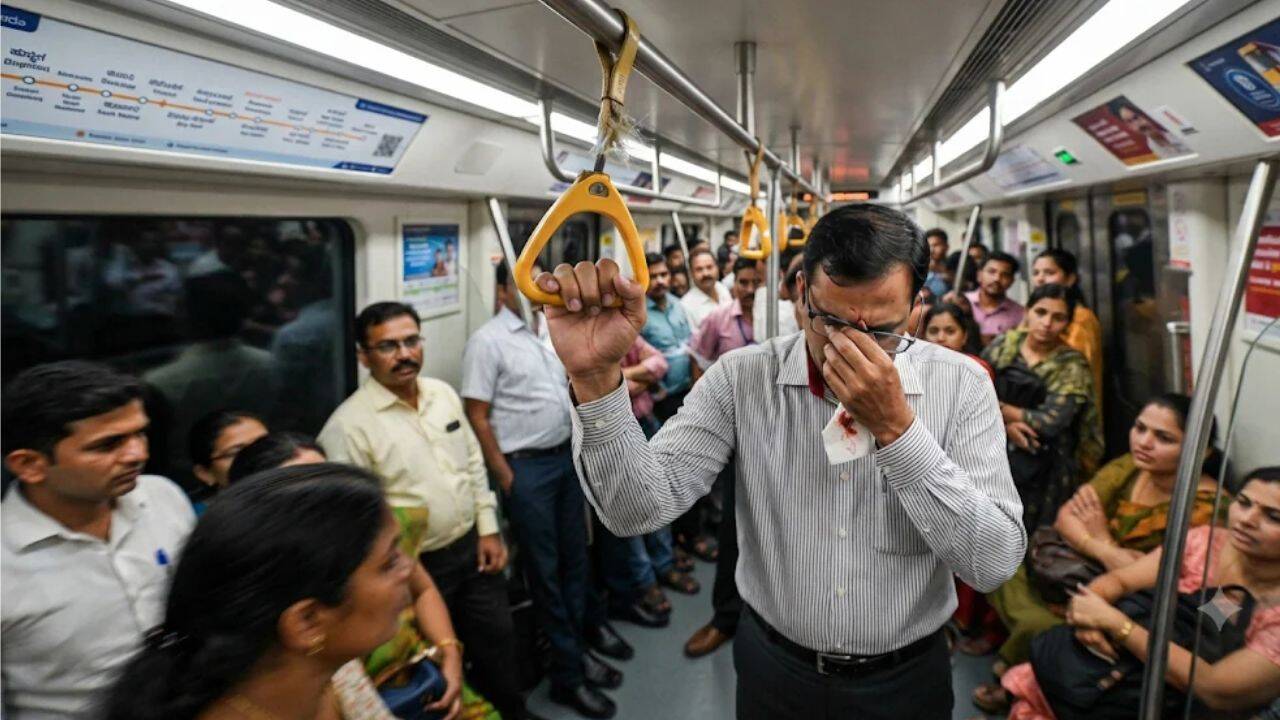
A recent incident on the Bengaluru Metro has highlighted safety concerns for daily commuters. A man suffered a nose injury and broke his Rs 3,000 spectacles when a grab handle detached from the train carriage while he was holding onto it. The sudden breakage caused him to fall, resulting in physical harm and property damage. The incident has raised questions about the maintenance and quality control of the Metro system's equipment. Commuters rely on these handles for stability, especially during sudden stops or turns, making their integrity a critical safety feature. The failure of the handle to withstand normal use has led to a formal complaint against the Bangalore Metro Rail Corporation Limited (BMRCL).
In its defense, the BMRCL argued that the passenger had placed his entire body weight on the handle, which is not its intended use. The authority claimed that the handle was designed for gripping, not for supporting full body weight. However, the BMRCL failed to produce CCTV footage from the incident to substantiate this claim. The lack of video evidence weakened the corporation's position in the consumer complaint case. The consumer commission noted that the burden of proof lies with the service provider when such incidents occur, and the absence of footage was a significant oversight in their defense strategy.
The consumer commission ultimately ruled in favor of the passenger, ordering the BMRCL to pay Rs 5,000 in compensation. This amount covers the cost of the damaged spectacles and provides a modest sum for the pain and suffering caused by the injury. The ruling serves as a reminder to public transport authorities to maintain rigorous safety standards and to preserve evidence for potential disputes. For readers in India, this case underscores the importance of consumer rights in public services and the need for transparent accountability from government-owned transport bodies. It also highlights the vulnerability of commuters when infrastructure fails, prompting a broader discussion on safety audits for urban transit systems.
Comments 0