Mumbai Abandons ₹702 Crore Metro Coastal Link Beneath Historic Racecourse
The Brihanmumbai Municipal Corporation has scrapped a controversial underground passage beneath the Mahalaxmi racecourse, forcing a redesign of the Metro-Coastal Road connector. The decision marks a rare victory for heritage advocates against infrastructure imperatives.
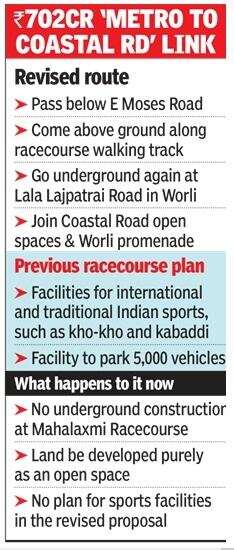
The concrete rupture occurred when the municipal commissioner announced the cancellation of the underground passage designed to link Metro Line 3 with the Coastal Road beneath the 225-acre Mahalaxmi racecourse. The ₹702 crore component had been justified as essential for seamless multimodal connectivity, yet environmental clearances and heritage objections had stalled construction for years. The scrapping forces a fundamental redesign of the interchange, pushing costs and timelines into uncertain territory.
The underlying tension reveals a city governance model where infrastructure agencies operate in silos, each optimizing for its own corridor without resolving intermodal conflicts at the planning stage. Institutional friction appears in the railway ministry's insistence on alignment integrity, the municipal corporation's heritage conservation mandate, and the state government's coastal road deadline , each legitimate, none reconcilable without political arbitration. The racecourse, leased to the Royal Western India Turf Club until 2033, became the physical manifestation of these competing claims.
Downstream casualties include commuters who lose a grade-separated interchange, contractors facing claim disputes on sunk costs, and the credibility of Mumbai's integrated transport master plan. The tangible outcome is a forced surface-level integration that will add minutes to every transfer, increase conflict points with vehicular traffic, and embed a permanent capacity constraint into the city's most expensive transit corridor.
Comments 0